
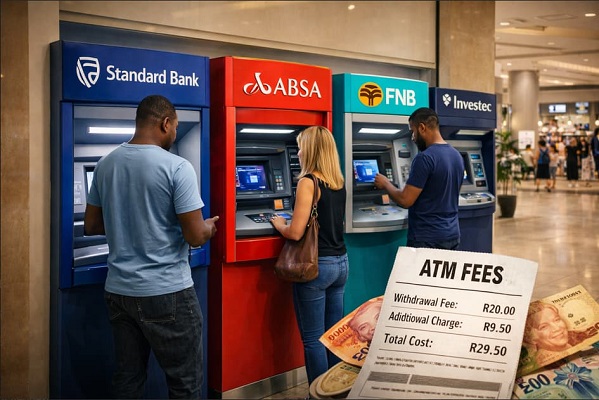
ATM Withdrawal Fees in South Africa. I Thought It Was “Just a Few Rands”
After publishing my article on the most overpaid South African bank fees, I decided to test something properly.
I opened my own bank statement.
Then I filtered only ATM withdrawals.
What I saw honestly surprised me.
Each fee looked small:
- R7.50 here
- R12.00 there
- R18.90 somewhere else
Individually? Nothing dramatic.
But together?
It was over R280 for the month.
That’s when I realised something important:
ATM withdrawal fees in South Africa don’t hurt you once. They hurt you repeatedly.
In this article, I’m breaking everything down in plain English, no complicated banking jargon, so you can see exactly where your money might be going.
👉 Read more: Are You Paying Too Much for ATM Withdrawals in South Africa?
TABLE of CONTENTS:
Important Notes:
- ATM withdrawal fees in South Africa usually include a base fee plus a per-R100 charge.
- Using another bank’s ATM is significantly more expensive.
- Small, frequent withdrawals cost more than larger, planned withdrawals.
- Pay-per-use accounts feel ATM fees more than bundled accounts.
- You can reduce these fees immediately with small habit changes.
First, Let’s Explain How ATM Fees Actually Work
Before we talk numbers, let’s simplify the structure.
Most banks charge ATM fees using this formula:
Flat base fee + fee per R100 withdrawn
That means you’re paying:
- A fixed amount just for using the ATM
- Plus a variable amount depending on how much you withdraw
Let’s Take Example
If the fee structure is:
- R5.00 base fee
- R1.50 per R100 withdrawn
And you withdraw R1,000:
- R5.00 + (R1.50 × 10)
- = R5.00 + R15
- = R20 total fee
Now multiply that by four withdrawals per month.
That’s R80.
Over 12 months?
R960.
And that’s if you only withdraw R1,000 at a time.
Own-Bank ATM vs Other-Bank ATM: The Big Difference
Here’s where many people unknowingly overpay.
What Is an Other-Bank ATM Fee?
This happens when:
- You bank with Bank A
- But withdraw cash from Bank B’s ATM
Because ATM networks are shared, banks charge extra for “foreign” usage.
And it’s not a small difference.
In many cases:
- Own-bank ATM withdrawal: Lower base + lower per-R100 rate
- Other-bank ATM withdrawal: Higher base + higher per-R100 rate
For Instance
Let’s say you withdraw R500.
At your own bank’s ATM:
- Fee might be around R8–R12
At another bank’s ATM:
- Fee could jump to R15–R25
If you do this twice a week, you’re potentially paying double what you need to.
I’ve done this myself at malls. Convenience wins, but my wallet loses.
Audit your bank fees to identify recurring or hidden charges, and prepare evidence to dispute incorrect fees.
Why Small Withdrawals Cost More (Even If You Think They Don’t)
This is where behaviour matters.
Imagine two people:
Person A:
Withdraws R2,000 once.
Person B:
Withdraws R500 four times.
Even though both withdraw R2,000 total, Person B pays the base fee four times.
That’s the hidden trap.
The more often you withdraw, the more times you trigger the base fee.
And that base fee is unavoidable.
Pay-Per-Use Accounts Feel This the Most
Let’s clarify something important.
What Is a Pay-Per-Use Account?
It’s a bank account where:
- You pay for each transaction separately.
- There is often a low or zero monthly fee.
- But every action (withdrawal, debit order, transfer) has a charge.
These accounts seem cheaper upfront.
But if you:
- Withdraw frequently
- Use other-bank ATMs
- Make many transactions
You may end up paying more overall.
Bundled accounts (which we’ll cover in another article) often include limited free withdrawals, which can reduce ATM costs significantly.
👉 Read more: Pay-Per-Use vs Bundled Bank Accounts in South Africa
The Psychological Trap of ATM Fees
Let me explain why ATM withdrawal fees in South Africa are so easy to ignore.
- They’re small amounts.
- They’re attached to a useful action (getting cash).
- Spread throughout the month.
- They don’t feel like a “bill.”
Unlike your R99 monthly fee, ATM fees feel invisible.
But invisibility doesn’t mean insignificant.
When ATM Fees Hit Hardest
From my research and reader feedback, ATM fees affect certain groups more:
- Students who withdraw small amounts weekly
- People paid weekly
- Cash-based earners
- Households relying on grants
- Anyone without easy access to their own bank’s ATM
Ironically, those with tighter budgets often pay more in percentage terms.
How to Calculate Your Real Annual ATM Cost
Here’s what I suggest you do right now.
Step 1: Open your banking app.
Step 2: Filter ATM withdrawals for last month.
And step 3: Add the total fees.
Now multiply that by 12.
That’s your annual ATM cost.
For many people, it falls between:
- R800
- R1,500
- Sometimes even R2,000+
And that’s just for accessing your own money.
📢 Request a Customized Ad Space for Your Business!
Showcase your business brand to thousands of engaged readers.
Place your message and connect directly with South African banking consumers.
Best Ways to Reduce ATM Withdrawal Fees in SA
Now let’s talk solutions, because awareness without action doesn’t help.
1. Withdraw Larger Amounts, Less Often
This reduces how many times you pay the base fee.
Instead of:
- R300 every few days
Try:
- One planned weekly withdrawal
2. Stick to Your Own Bank’s ATMs
Yes, it might require walking further.
But over a year?
It could save hundreds.
3. Use Digital Payments Where Possible
Card payments and instant EFTs are often cheaper than cash withdrawals.
If you’re paying a domestic worker or small vendor, ask:
- Do they accept transfers?
- Do they have mobile payment options?
Even partial digital usage helps.
4. Check If Your Account Includes Free Withdrawals
Some bundled accounts include:
- 2–4 free ATM withdrawals monthly
If you’re already paying a monthly account fee, make sure you’re using what’s included.
5. Plan Cash Needs in Advance
Impulse withdrawals cost more.
If you know you’ll need cash for:
- Weekend markets
- Family events
- School contributions
Withdraw once.
Not three times.
When Paying ATM Fees Makes Sense
I’m not anti-cash.
ATM withdrawals make sense when:
- You need cash for safety reasons
- You don’t want to rely on card machines
- Your account includes free withdrawals
- You’re withdrawing larger planned amounts
The key is intentional use, not habit-based use.
👉 Read more: How to Reduce Your Monthly Bank Fees Without Changing Banks
A Quick Reality Check
Let me be honest with you.
When I first ran my own numbers, I felt slightly annoyed, not at the bank, but at myself.
The information was always there.
The pricing guides were always available.
But I never calculated the impact.
Once I did, reducing my ATM withdrawal fees in South Africa became easy.
Not because I changed banks.
But because I changed behaviour.
Common Myths About ATM Withdrawal Fees in SA
Let’s clear up a few misunderstandings.
“It’s just a few rands.”
Small amounts multiplied frequently become big amounts.
“All ATMs cost the same.”
They don’t. Other-bank ATMs almost always cost more.
“My monthly account fee covers everything.”
Usually, it doesn’t.
Always check your pricing guide.
Where This Fits Into Your Bigger Financial Picture
ATM fees alone won’t make you rich.
But they represent something bigger:
Financial awareness.
Once you start noticing small fees, you start noticing:
- Subscription creep
- Debit order charges
- SMS notification fees
- Transfer costs
And that’s when real savings begin.
Conclusion
If I had to summarise this entire article in one sentence, it would be this:
ATM withdrawal fees in South Africa aren’t expensive because of one transaction, they’re expensive because of repetition.
You don’t need a new bank.
You don’t need a financial advisor.
And you don’t need complex strategies.
You just need:
- Awareness
- Slight habit adjustments
- And 10 minutes reviewing your statement
I always say this on the blog:
Money leaks are rarely dramatic.
They’re quiet.
And once you spot them, they’re surprisingly easy to fix.
