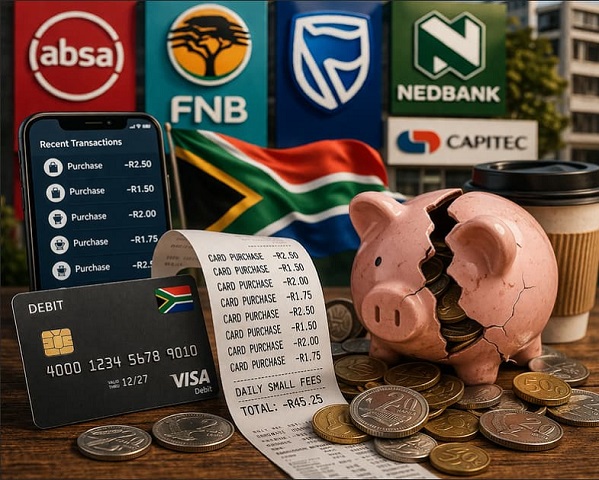
Key Takeaway on Transaction Fees South Africa:
- I used to think monthly bank fees were the biggest cost, I was wrong.
- Small transaction fees added up quietly every single month.
- Once I tracked my banking behaviour, I realised where my money was actually going.
- If you’re not paying attention to transaction fees South Africa, you might be overspending without realising it.
TABLE of CONTENTS:
👉 Read also: How to avoid penalty fees and debit order charges
What I Realized That Changed How I Look at Bank Fees
For years, I focused only on the monthly account fee when comparing bank accounts. If the monthly fee looked low, I assumed I was saving money. That’s what most of us do, right?
But one day I sat down and actually checked my bank statement line by line. That’s when it hit me, those small transaction charges I never paid attention to were adding up way faster than the monthly fee.
And honestly, it surprised me.
I realised that the real cost of my account wasn’t the monthly fee. It was how often I used the account, ATM withdrawals, transfers, debit orders, all those tiny charges quietly stacking up.
That’s when I started digging deeper into how transaction fees in South Africa really work.
What Transaction Fees South Africa Actually Mean
When I say transaction fees South Africa, I’m talking about the small charges your bank takes every time you do something with your account.
Think about things like:
- Withdrawing cash from an ATM
- Sending money via EFT
- Using instant payment options
- Having a debit order processed (or returned)
Each action seems small on its own. But when you do them multiple times a month, they quickly become the main cost of your banking.
The Moment I Did the Math (And You Should Too)
Let me show you something practical from my own experience using our free monthly fee calculator plan to estimate and dispute any incorrect fees.
One month, I checked:
- I withdrew cash about 6 times
- Made around 5 transfers
- Had 3 debit orders go through
Each of those had a small fee. Individually, they looked harmless. But when I multiplied those small fees across 12 months, the number shocked me.
My monthly account fee was around R25.
But my yearly transaction charges? Way over R1,500.
That’s when I understood why transaction fees in South Africa matter more than we usually think.
Audit your bank fees to identify recurring or hidden charges, and prepare evidence to dispute incorrect fees.
The Small Charges I Personally Overlooked
ATM Withdrawal
I used to withdraw cash whenever I needed it. Quick trip to the ATM, done. But each withdrawal carried a fee. I didn’t notice because it was small.
Now I try to withdraw fewer times per month. That simple habit already lowered my costs.
💡 Tip: Fewer, larger withdrawals usually cost me less than multiple small withdrawals.
EFT and Instant Transfers
I also loved using instant transfers. It felt convenient, money moves immediately. But convenience has a price. Instant transfers are usually more expensive than standard ones.
Once I slowed down and planned my payments better, I noticed how much I saved just by avoiding instant transfers when I didn’t really need them.
💡 Tip: Avoid instant EFTs unless timing is critical.
Debit Orders (The Silent Triggers)
This one caught me off guard the most.
If a debit order hits when your balance is low, you don’t just get one fee. Sometimes you get multiple charges linked to that failed transaction.
That’s why I now align my debit orders closer to payday. It’s a small adjustment, but it prevents unnecessary charges.
👉 Read also: Best Low-Fee Bank Accounts for Low-Income Users in SA
Why These Small Fees Add Up Faster Than Monthly Charges
Here’s the truth I learned: your monthly fee is predictable. Transaction fees are behaviour-driven.
If you’re active on your account like I am, paying bills, withdrawing cash, sending money, your real cost grows with every action.
So even if your account advertises a low monthly fee, the actual cost depends on how you use your money day to day.
That’s the part banks don’t always explain clearly.

📢 Request a Customized Ad Space for Your Business!
Showcase your business brand to thousands of engaged readers.
Place your message and connect directly with South African banking consumers.
Comparing Account Types (From My Perspective)
When I compared accounts properly, I realised each type is built for different behaviour.
Entry-Level Accounts
These usually have very low monthly fees. I initially thought they were the cheapest. But they charge more per transaction, so frequent users like me end up paying more overall.
Bundled Accounts
These charge a higher monthly fee but include many transactions for free. When I calculated my usage, this type actually made more sense for me.
Digital-Only Accounts
If you’re comfortable using apps and avoiding cash withdrawals, digital banks can be cheaper because their transaction fees are lower.
But you need to be honest with yourself about your habits. If you still use cash a lot, the savings might not be as big as advertised.
👉 Read also: How to compare bank accounts using real usage scenarios
How I Calculated My Real Banking Cost (Step-by-Step)
If you want to see the real picture like I did, try this:
- Open your banking app and check last month’s transactions.
- Count how many withdrawals, transfers, and debit orders you had.
- Multiply each by the fee your bank charges.
- Add everything up and multiply by 12 months.
That number is your true yearly cost, not just the monthly fee.
It’s a simple exercise, but it completely changed how I evaluate bank accounts.
The Habits That Helped Me Reduce My Bank Fees
After noticing how transaction fees South Africa were affecting my budget, I made a few changes:
- I reduced how often I withdraw cash
- I stopped using instant transfers unless absolutely necessary
- Planned debit orders around my salary date
- Compared bundled accounts more realistically
These weren’t drastic lifestyle changes. Just small adjustments that made a noticeable difference over time.
👉 Read also: How to Reduce Monthly Bank Fees in South Africa
Imagine someone who withdraws cash four times a week because they prefer using cash. Each withdrawal has a small fee. Over a month, that’s already a noticeable cost. Over a year, it becomes significant.
That used to be me.
Once I switched to using my card more often and withdrew cash less frequently, my banking costs dropped without me changing anything else in my financial life.
Why This is Important for Everyday South Africans
For many of us, banking is something we don’t actively think about. We just use our accounts daily and assume the charges are normal.
But when transaction fees South Africa go unchecked, they quietly reduce the money we could be saving or investing.
Understanding these fees is not just about banking knowledge, it’s about protecting your monthly budget.
👉 Read also: Monthly bank fees compared across South African banks
Conclusion: After Tracking My Transaction Fees South Africa
The biggest lesson I learned is this: the cheapest account is not always the one with the lowest monthly fee. It’s the one that matches how you actually use your money.
Once you pay attention to your own habits, it becomes easier to choose the right account and avoid unnecessary charges.
So if there’s one thing I’d recommend, it’s this: spend just 10 minutes reviewing your last bank statement. You might discover, like I did, that the small transaction fees you ignored are the ones costing you the most.