
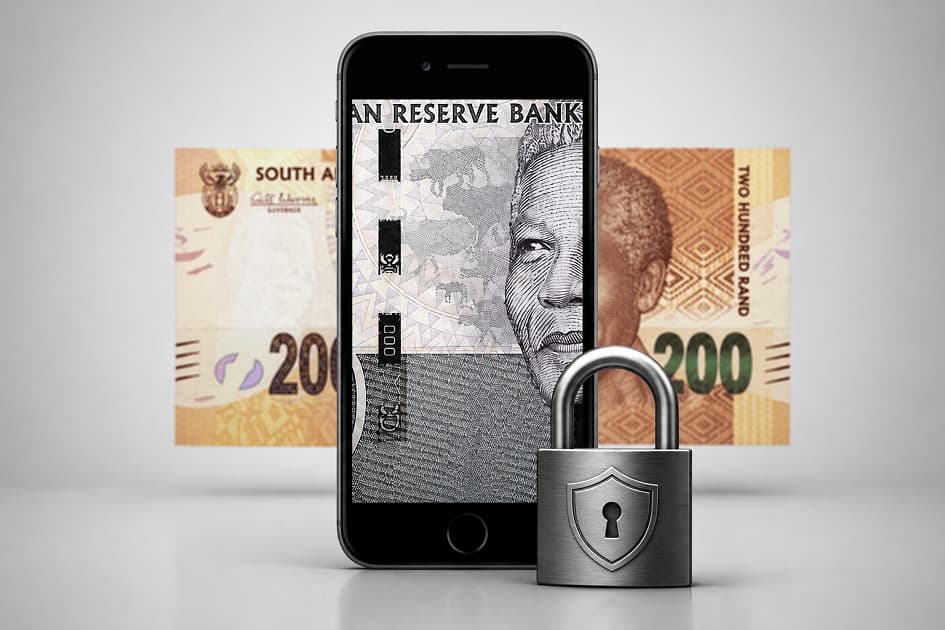
The growth of Digital Banks in South Africa has made banking more convenient. You can open or manage an account from a smartphone, move money without visiting a branch, create savings goals, receive instant transaction alerts and control cards from an app.
But convenience naturally raises another question: how safe is your money when so much of your banking happens digitally?
The answer requires looking beyond whether a bank has branches. A digital-first bank can be a regulated bank with the same broader banking regulatory framework that applies to other registered banks. At the same time, digital banking introduces risks that customers need to understand, including phishing, social engineering, account takeover, device theft and fraudulent transactions.
South Africa also has a formal deposit-insurance system. The Corporation for Deposit Insurance (CODI), a wholly owned subsidiary of the South African Reserve Bank (SARB), protects qualifying deposits up to R100,000 per qualifying depositor per registered bank if a member bank is placed into resolution.
That protection is important, but it does not mean every digital-banking risk disappears.
The safest approach is to understand how the bank is regulated, what protection applies to your deposits, how transactions are secured and what you can do to protect your own account.
Key Points:
- Digital Banks in South Africa can be legitimate regulated banks, so being app-based does not by itself make a bank unsafe.
- CODI membership is compulsory for registered banks, and qualifying deposits are protected up to R100,000 per depositor per registered bank under the applicable rules.
- Deposit insurance protects qualifying deposits if a bank enters resolution; it is not insurance against phishing, scams or an unauthorised transaction.
- Digital banking fraud remains a significant South African consumer risk. SABRIC reported that digital banking crime losses reached R2.4 billion in 2025, with banking-app-related crime accounting for more than 70% of reported digital banking losses.
- A secure banking app cannot protect a customer who voluntarily gives criminals passwords, PINs or verification information.
- Savings pockets and digital savings accounts can be useful, but customers should check the interest rate, access rules, fees and applicable deposit-protection conditions.
- Security should be considered alongside fees, transaction limits, customer support and the bank’s ability to provide assistance when something goes wrong.
First, What Does “Safe” Actually Mean?
When people ask whether digital banks are safe, they may actually be asking several different questions.
Is the bank financially sound?
Will my deposits be protected if the bank fails?
Can someone steal money from my account?
Can criminals access my banking app?
Will my personal information be protected?
Can I recover money after an unauthorised transaction?
These are separate issues.
A bank can be financially regulated while a customer can still fall victim to phishing. Similarly, a sophisticated banking application cannot protect an account if the customer gives a criminal their login credentials.
That distinction is important because bank safety and digital-security safety are related, but they are not identical.
Are Digital Banks Regulated in South Africa?
A digital-first bank is not automatically outside the conventional banking regulatory framework simply because customers interact with it primarily through an app.
The Prudential Authority supervises banks and other financial institutions with the objective of promoting a safe and resilient financial system. Its 2025/26 annual report says its supervisory work assesses the resilience and governance of regulated institutions and seeks to identify weaknesses early.
The SARB also plays a broader role in financial stability and oversees the national payment system.
This means consumers should start with a very basic check before depositing substantial money with any institution:
Is it actually a registered bank, and what regulatory protections apply to the particular product?
The word “digital” should never be treated as proof of either safety or danger.
CODI Is One of the Most Important Protections for Depositors
South Africa’s deposit-insurance system changed the conversation around bank safety when CODI became operational on 1 April 2024.
CODI is responsible for protecting qualifying depositors if a member bank is placed into resolution. The current protection level is up to R100,000 per qualifying depositor per registered bank.
Membership is compulsory for registered banks covered by the relevant banking legislation.
The SARB’s current CODI member list includes well-known traditional institutions such as Absa, Capitec, FirstRand, Nedbank and Standard Bank, as well as digital-oriented institutions including Bank Zero and TymeBank.
This is particularly relevant when evaluating Digital Banks in South Africa.
A customer should not assume that an app-based banking experience means there is no institutional safety net.
What happens if you have more than R100,000?
The R100,000 limit matters.
CODI’s current framework protects qualifying deposits up to R100,000 per depositor, per registered bank. If a depositor has more than that amount, CODI provides access to the protected amount, while amounts above the coverage limit are dealt with through the applicable resolution or liquidation process.
For someone holding a large cash balance, this makes the distinction between per depositor and per bank particularly important.
The limit is not R100,000 across every bank you use. It applies per qualifying depositor at each registered bank, subject to the rules governing covered deposits.
What CODI Does Not Protect You From
CODI should not be confused with fraud insurance.
If someone tricks you into revealing your banking credentials, that is a different problem.
CODI exists to protect qualifying deposits in the event of a bank being placed into resolution. It is not designed to reimburse customers simply because they clicked a fraudulent link or disclosed a one-time password.
This is one of the most important distinctions consumers should understand.
Deposit protection deals with bank failure. Cybersecurity deals with unauthorised access and fraud.
Both matter, but they address different risks.
Digital Banking Fraud Is a Real South African Risk
There is good reason to take digital security seriously.
SABRIC’s 2025 annual banking-crime statistics, released in August 2026, reported that losses from digital banking crime increased to R2.4 billion in 2025, compared with approximately R1.9 billion in 2024. SABRIC said banking-app-related crime accounted for more than 70% of reported digital-banking losses.
These figures are not evidence that digital banks themselves are inherently unsafe.
They demonstrate that criminals increasingly target digital channels.
The difference matters.
A criminal does not necessarily need to break into a bank’s central systems. In many scams, the target is the customer.
That can involve pretending to be a bank employee, sending a convincing message, creating a fake website or persuading someone to approve a transaction.
The security conversation therefore has to include customer behaviour as well as bank technology.
The Most Dangerous Weakness May Be Social Engineering
Sophisticated fraud does not always look like traditional hacking.
A customer might receive a message claiming that their account has been compromised. The message may instruct them to click a link, call a number or confirm a transaction.
The criminal’s objective is to create urgency.
Once the customer becomes worried, they may provide information that allows the criminal to access the account or authorise transactions.
This is known as social engineering.
The warning signs are often more important than the technical details:
- Someone unexpectedly asks for your password or PIN.
- You are pressured to act immediately.
- A person claiming to be from your bank asks for a one-time password.
- You are told to move money to a “safe” account.
- A message contains a suspicious link.
- You are asked to install software or give someone remote access to your device.
A genuine bank’s security system cannot completely compensate for a customer voluntarily handing sensitive information to a criminal.
What Security Features Should You Look For?
Different banks implement security differently, so customers should check the specific institution’s current features.
Common protective measures can include biometric authentication, multi-factor authentication, transaction notifications, card controls, device recognition, fraud monitoring and encryption.
For example, GoTyme Bank says its security measures include biometric verification, multi-factor authentication, encryption, 24/7 fraud detection and regular security audits.
Those features can make unauthorised access more difficult, but they should not be interpreted as a guarantee that fraud is impossible.
Security is best understood as multiple layers.
The bank provides technological and organisational controls. The customer protects the device and credentials. Both layers matter.
Your Phone Is Now Part of Your Banking Security
With traditional branch banking, losing your phone was not necessarily a financial emergency.
With digital banking, your smartphone can become one of the most important access points to your money.
That makes basic phone security part of financial security.
Use a strong device passcode and keep your operating system and banking applications updated. Avoid installing applications from untrusted sources, and do not allow strangers remote access to your phone.
If your phone or SIM is lost or stolen, contact the relevant providers and your bank as quickly as possible.
You should also review your bank’s procedures for changing your phone number, replacing a device and recovering account access.
Public Wi-Fi and Banking
Public networks can create additional security concerns.
That does not mean every public Wi-Fi network is automatically dangerous, but customers should avoid unnecessary exposure when conducting sensitive financial transactions.
Your safest routine is generally to use a trusted connection, keep your device updated and use the bank’s official application or website rather than following links from unsolicited messages.
The key principle is simple: make it difficult for criminals to intercept or manipulate your banking session.
Transaction Alerts Can Help You Catch Problems Quickly
Transaction notifications are one of the most useful features of digital banking.
If you receive an alert immediately after a transaction, you have an opportunity to identify something suspicious quickly.
This is particularly useful when a card is compromised or an unfamiliar payment appears.
Do not ignore small suspicious transactions simply because the amount is low.
Fraudsters can test compromised accounts with smaller transactions before attempting larger ones.
Review your account regularly and report suspicious activity according to your bank’s procedures.
The faster you respond, the more information the bank may have available to investigate the incident.
What About Savings Pockets?
Digital savings features can make it easier to separate money from everyday spending.
A customer might create separate savings goals for emergencies, school expenses, holidays or annual bills.
This is useful for budgeting because the money is visually separated from the balance used for daily transactions.
But a savings pocket is not automatically safer simply because it is called a “pocket.”
You still need to understand:
- Whether the money is held as a qualifying deposit
- The applicable interest rate
- Whether withdrawals are restricted
- Whether fees apply
- Whether the product has a notice period
- How the balance is treated under the bank’s terms
CODI protection depends on the nature of the qualifying deposit and the applicable rules, not simply the name displayed inside an app. CODI states that protection applies to qualifying deposits and provides cover up to R100,000 per qualifying depositor per registered bank.
Is Money in a Digital Bank as Safe as Money in a Traditional Bank?
There is no blanket answer based solely on the bank’s digital or traditional label.
The more useful comparison is between specific institutions and products.
A registered bank is subject to the relevant regulatory and prudential framework regardless of whether customers primarily interact through branches or an application.
The SARB’s current CODI member list illustrates this clearly: both traditional and digital-oriented banks appear within the deposit-insurance framework.
Therefore, a consumer should not reason:
“It is a digital bank, so my money is less safe.”
Nor should the opposite assumption be made:
“It is a digital bank, so technology makes it safer.”
The actual assessment requires checking the institution, regulatory status, applicable deposit protection and security controls.
Digital Banks Can Also Be More Convenient During Everyday Banking
Safety is not only about avoiding fraud.
A good banking system should also allow you to monitor and control your money effectively.
Digital banks can provide useful tools such as:
- Instant transaction notifications
- In-app card controls
- Digital statements
- Savings goals
- Account management
- Electronic payments
- Remote customer support
These features can help customers identify problems and manage money without waiting for a branch to open.
That is one reason Digital Banks in South Africa can be attractive even to customers who remain cautious about security.
The convenience and security features can complement each other when used properly.
But Digital Banking Has Its Own Operational Risks
Not every risk involves criminals.
Digital banking depends on technology, telecommunications and electricity.
A service outage, internet disruption, mobile-network problem or technical failure can temporarily prevent customers from accessing accounts or making transactions.
The SARB has identified operational risks such as cyber incidents, failures of critical third-party service providers, payment-system disruptions, telecommunications or internet outages and electricity-grid failures as risks that can affect the financial system.
This does not mean digital banks are unreliable.
It means customers should understand that digital access itself is an infrastructure dependency.
Keeping an alternative payment method available can be sensible, particularly when you rely heavily on one banking application.
What If Your Banking App Stops Working?
A temporary app problem does not necessarily mean your money has disappeared.
It may be an application issue, network problem, scheduled maintenance or wider service interruption.
The sensible response is to check the bank’s official service-status communication rather than immediately responding to messages claiming your account has been compromised.
Do not download an unofficial “replacement banking app” sent through a message.
If you cannot access your account and suspect something more serious, use the bank’s official support channels.
This is another reason to keep official contact details saved rather than relying on a phone number contained in a suspicious SMS or email.
How Safe Are Digital Payments?
Digital payments can be highly convenient, but customers need to understand that different payment methods work differently.
An ordinary EFT, an immediate payment, a card transaction and a real-time payment service may have different processing times, fees and security procedures.
Before sending a large amount of money, verify the recipient details carefully.
A fraudulent transfer can be difficult to reverse once authorised, particularly if the customer personally approved the transaction.
This is why transaction confirmation screens should never be treated as a formality.
Check the recipient, amount and payment method before approving.
What Should You Do If You Suspect Fraud?
Act quickly.
If you notice an unfamiliar transaction or believe someone has accessed your banking credentials, contact your bank through an official channel immediately.
Depending on the situation, the bank may be able to block cards, restrict account access or investigate transactions.
You should also change compromised credentials where appropriate and secure your device.
Do not continue communicating with the suspected scammer while trying to resolve the problem.
If the fraud involved a suspicious message, website or phone call, keep the relevant evidence where possible.
The important thing is not to wait because you are embarrassed or unsure whether the transaction is fraudulent.
How to Check Whether a Digital Bank Is Legitimate
Before opening an account, especially with a lesser-known institution, perform several checks.
First, verify that you are dealing with the actual bank rather than an impersonator.
Second, confirm the institution’s regulatory and registration information through official sources.
Third, check whether the institution appears on the SARB’s relevant bank and CODI information.
Fourth, download applications only through legitimate app stores and verify that the developer information corresponds with the bank.
Finally, read the account terms and pricing before depositing money.
A professional-looking website is not proof of legitimacy.
Neither is a large number of social-media followers.
Do Digital Banks Have Lower Security Because They Have Fewer Branches?
No conclusion like that can be made simply from the number of branches.
Branches and cybersecurity solve different problems.
A branch can provide face-to-face assistance, but it does not prevent phishing or account takeover.
Likewise, a sophisticated mobile application does not eliminate the need for customer support.
The important question is whether the bank has appropriate security, fraud monitoring, customer authentication, incident-response procedures and regulatory oversight.
A bank with fewer branches can still have substantial technological and regulatory infrastructure.
What Customers Should Never Share
There are certain pieces of information that should be treated as highly sensitive.
Never casually share your banking password, PIN, authentication codes or other security credentials with someone claiming to represent your bank.
If someone contacts you unexpectedly and asks for information that could allow them to access your account, stop the conversation and contact the bank through an official channel.
GoTyme’s published banking guidance similarly emphasises that customers have responsibilities to take reasonable measures to prevent fraud or theft from their accounts.
That principle applies broadly across banking.
Digital Banking Security Is a Shared Responsibility
Banks have significant responsibilities.
They need to maintain secure systems, monitor suspicious activity, protect customer information, manage operational risks and comply with applicable regulatory requirements.
Customers have responsibilities too.
They need to protect devices, credentials and personal information, question unexpected requests and report suspicious activity promptly.
Neither side can eliminate every risk alone.
This is particularly important as banking becomes increasingly digital and criminals develop more sophisticated ways to target customers.
How to Protect Your Money When Using Digital Banks in South Africa
A practical security routine does not need to be complicated.
Use the bank’s official application, keep your device and banking app updated, enable available security features and monitor transaction alerts.
Do not click banking links from unexpected messages. If you receive a warning about your account, open the bank’s official app or manually access its official website instead.
Review your transactions regularly.
Use a unique password where applicable and protect your phone with a secure screen lock.
If you lose your device or suspect that your account has been compromised, contact the bank immediately.
Most importantly, do not allow urgency to override verification.
Scammers want customers to act before thinking.
Security Should Be Part of Your Bank Comparison
When comparing Digital Banks in South Africa, security should sit alongside fees rather than being treated as a separate issue.
A low-fee account may be attractive, but you should also examine:
- Regulatory status
- CODI membership and applicable deposit protection
- Authentication methods
- Fraud monitoring
- Transaction notifications
- Customer support
- Card controls
- Account recovery procedures
- App reliability
- Privacy and data-handling policies
The same principle applies when comparing digital-first and traditional banks.
This related guide Digital Banks vs Traditional Banks in South Africa: Fees, Savings Pockets, Security, and Everyday Banking looks at these differences from a broader consumer perspective.
If fees are your main concern, see Digital Bank Fees and Challenger Banks Fees in South Africa and How Digital Banks Keep Fees Low in South Africa.
Do Lower Fees Mean Higher Risk?
Not necessarily.
A bank can offer low fees because of its operating model, pricing strategy, customer-acquisition strategy or competitive positioning.
Fees are not a direct measure of cybersecurity.
Similarly, paying a high monthly account fee does not guarantee that an account is safer.
This is why consumers should avoid using price as a shortcut for judging security.
Our Hidden Costs of Digital Banking in South Africa guide can help with the cost side, while this article focuses on the separate question of safety.
What About Your Savings If a Bank Fails?
This is where CODI becomes especially important.
If a registered bank is placed into resolution, qualifying depositors have protection up to R100,000 per qualifying depositor per registered bank under the current framework. CODI says the amount includes savings and interest where applicable.
As a result, consumers should understand where their cash is held and whether the particular product qualifies.
Do not assume that every financial product offered through a banking application is automatically covered simply because it appears inside a bank’s app.
Read the product documentation.
Should You Keep Money in More Than One Bank?
There is no universal requirement that every consumer must use multiple banks.
However, people with larger cash balances may consider how deposit-insurance limits interact with the amount they hold at one institution.
Because CODI coverage is calculated per qualifying depositor per registered bank, the structure of your deposits matters.
This is a financial-planning consideration rather than a recommendation to open accounts simply for the sake of having several banks.
The right decision depends on your circumstances, liquidity needs, fees and the purpose of the money.
The Bottom Line: Are Digital Banks Safe?
Digital Banks in South Africa can be safe, but “digital” is not itself a safety guarantee.
The strongest indicators are the bank’s regulatory status, prudential supervision, applicable deposit protection, security controls, fraud-monitoring systems, customer-support processes and your own account-security habits.
South Africa’s regulatory framework provides an important layer of protection. Registered banks are subject to prudential supervision, and CODI provides qualifying deposit protection up to R100,000 per depositor per registered bank.
At the same time, the country’s latest banking-crime data shows that digital fraud is a serious consumer risk. SABRIC’s 2025 figures demonstrate why customers should take phishing, social engineering and account security seriously.
The sensible conclusion is therefore not that digital banking is unsafe.
It is that digital banking requires a different kind of vigilance.
The app may make banking easier, but customers still need to verify transactions, protect their credentials, secure their devices and understand what protection applies to their deposits.
When you combine those habits with a properly regulated bank and the protections available through South Africa’s financial-safety framework, digital banking can be a practical and secure way to manage everyday money.
Related Digital Banking Guides:
To understand the wider industry shift, see Why Are Banks Going Digital? What Digital Banking Means for Banks and South African Customers.
For a direct comparison of banking models, continue with Digital Banks vs Traditional Banks in South Africa: Fees, Savings Pockets, Security, and Everyday Banking.
For costs, explore Digital Bank Fees and Challenger Banks Fees in South Africa, How Digital Banks Keep Fees Low in South Africa, and Hidden Costs of Digital Banking in South Africa.
For account-fee comparisons, see Compare Major South African Bank Fees, Monthly Bank Fees Compared Across South African Banks, and How to Reduce Monthly Bank Fees in South Africa Without Changing Banks.
